William Shand
William followed his brother John to Jamaica and his story is best told as a continuation of his brother John's story.
John Shand fled to Jamaica after becoming indebted in Scotland. He became successful by managing the affaitrs of absent landlords. This role was given the name "atorney" (An agent or representative authorized to act on someone else's behalf.). In particular he was the atorney for George Watson Taylor.
The estates of absentees were, of necessity, administered by "planting attorneys,” who often lived at the proprietor's expense. The attorney charged a 5 to 6 percent commission on the sale price of every crop shipped to the British market. In addition, he received a 5 percent commission on the sale of any estate owned by the absentee proprietor. Innumerable opportunities existed for an unscrupulous attorney to enrich himself at the expense of his employer by inflating the price of stores or selling part of the crop on his own account.
Nor was it unusual for attorneys to buy plantation supplies from their own companies. With the great house and servants also at his disposal, a clever attorney who managed fifteen to twenty estates might make as much as £10,000 per year.
John Shand made a life in Jamaica managing estates and had a family by a freed slave named Frances Brown. He had a number of children by her between 1799 and 1816 which he sent to Britain. By the time he was 57 (1816) he was intending to return to Scotland. He must have taken out loans on his Jamaican properties and bought the Burn and Arnhall in Aberdeenshire in 1814 for £70,000. He sought out his creditors in Scotland and repaid his old debts. Returning to Scotland permanantly in 1818 and handing over his his affairs to his brother William. John died in 1825 aged 66.
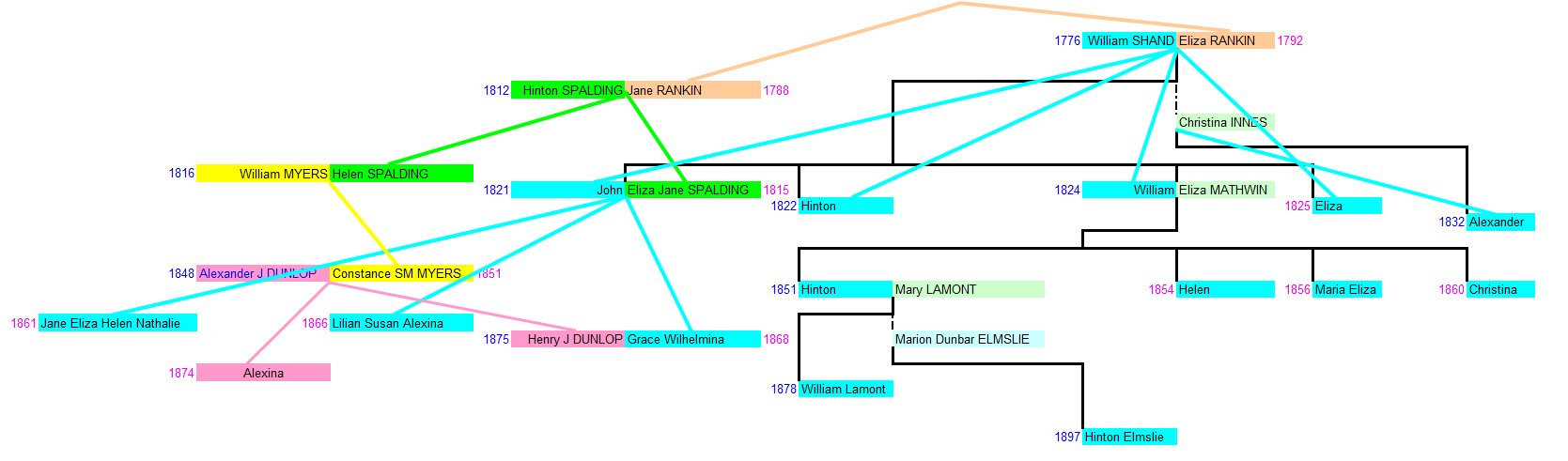
William continued as an atorney in Jamaica. He had married Eliza Jane Rankin. The Rankin family would later draw together the lives of their offspring over several generations..
He started to prepare for his return to Scotland in 1823 but was back in Jamaica in 1825. While he was out there his brother died in Scotland leaving the bulk of his estate to him. His wife gave birth to his daughter whilst out there but herself died a little later.
William returned to Scotland for good and married Christina Innes (aged 25) the following year (1826). Her family was well connected in Aberdeenshire her father owned Pitmedden House her sister married John Ramsay of Barra Castle and Straloch which she inherited on his death in 1832.
Planters in Jamaica had become increasingly worried about the economic effects of ending slavery. In 1832 William gave evidence to the Parliamentary enquiry On the Extinction of Slavery Throughout the British Dominions. The family debts now overwhelmed him and aged 58 (1834) he was subject to sequestration (bankruptcy). He was able to continue a reasonably comfortable lifestyle. He was staying with Susan Ramsay at Straloch House in 1835. In 1841 he is shown with his wife, five children and 3 servants at 1 Somerset Place, Glasgow though is only shown at that address for that year in the Post Office directory. His sons John and Hinton each gained a commision in the Madras Army of the East Indai Company. John is followed on the main Old Dunlops page. Hinton died aged 26.
John 1821's son William was a factor in John Scott (son of Charles Cunningham Scott)'s yard in France and married Eliza Jane MATHWIN. Their son Hinton (1851) married Mary Buchanan LAMONT and they had a son William Lamont SHAND (1878). If the old photograph that we have is indeed Willie Shand this may well be he. His obituary can be found on page 94 here.
William Shand's son with Christina Innes - Alexander Innes Shand went to Blairlodge School which implies that the family were still finacially viable. He went on to become a barrister and notable author.
William Shand died on 26 February.1845 there was a memorial in the churchyard of the Old Church at Dyce..
An interesting commentary on his life i was written by Matt Lee here
Sources:
University of Aberdeen - Records
List of correspondence George Watson Taylor with John and William Shand (PLANTATION LIFE IN THE CARIBBEAN Part 1: Jamaica, c.1765-1848: The Taylor and Vanneck-Arcedekne Papers from Cambridge University Library and the Institute of Commonwealth Studies, University of London)
The Economics of Emancipation: Jamaica and Barbados, 1823-1843 By Kathleen Mary Butler
Legacies of British Slave-ownership https://www.ucl.ac.uk/lbs/
Aberdeenshire Epitaphs and Inscriptions: with Historical,
Biographical, Genealogical, and Antiquarian Notes.. John A.