Bruce Alexander Johnstone Dunlop
Bruce Dunlop was born 19 Beacon Street, Middletown, New York (state) on 9thMay 1896. His father, Henry Johnstone Dunlop, had married his 2nd cousin once removed, Grace WJ Shand in London just over a year earlier.
He travelled to Britain from New York in 1998 aged 2. Though his parents went on to live in India he was brought up in Scotland, attended Loretto Nippers in Musselburgh and in 1911 went on to Bedford School with his younger brother Ronald John. It is not clear when he left but was registered there in 1913.


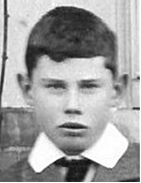
BAJ at Loretto Nippers

The Great War


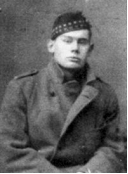
Britain declared war on Germany on 4th August 1914. Bruce enlisted in the cavalry in Dublin aged 18 on 2nd September 1914. His regiment was IV Hussars and he underwent training at Normanton Barracks, Derby. On 26th February 1915 while in Derby Bruce accidently shot himself in the calf while attempting to clean his pistol and was subjected to a Court of Inquiry. He recovered from his injury after a few weeks..
The 2nd Battalion Royal Irish Regiment had been decimated in a gas attack at Shell Trap Farm in the Battle of Bellewaarde (an action during the Second Battle of Ypres) on 24th May 1915 losing 396 from a strength of about 1000. They urgently needed battle casualty replacements. On 2 June BAJ was transferred to the Royal Irish Regiment, sent to France arriving on 28th June and joining the 2nd Battalion on 4th July.
The battalion was part of 4th Division which had been withdrawn from the front. It was one of the first British formations to move south to the Somme, where it took over the line from French troops just East of Beaumont Hamel at the end of July 1915. At the time this was a relatively quiet sector compared to the Ypres Salient. His time with the battalion was spent moving in and out of the line at weekly intervals and working on improving defences, Bruce was promoted to Lance Corporal on 2nd November. During the 5 months that he was with the battalion they lost 7 killed and 38 wounded through sniping, artillery and patrol activity. He was sent for Officer Training in December (6 months before his division would be engaged in the Battle of the Somme - more than three million men fought in that battle and one million men were wounded or killed, making it one of the bloodiest battles in human history).

On 25th December 1915 he was at Officer Cadet School in France. On 12th March 1916 he was commissioned as a Temporary 2nd Lieutenant in the 8th Battalion East Lancashire Regiment and granted home leave. While on leave he suffered a recurrence of an old knee injury and had an operation. He was on sick leave with an address in Derby during this period. Regular Medical Boards found him unfit for active service. In July 1916 he was ordered to relinquish his commission.
By September 1916 he felt fit enough to reapply for a commission and in November he was commissioned into the Royal Scots Fusiliers. He was posted to a holding unit 3rd (Reserve) Battalion RSF in Greenock. However the knee problems reoccurred and he was posted to 10th (Reserve) Battalion Seaforth Highlanders (later designated 39 Training Reserve Battalion) in Dunfermline. On 19th January 1917 he married Roberta (Robin) Brown from Greenock (the daughter of James and Sarah Brown). He was 20 and she 21.

It was not until later in 1917 that he was passed fit for active service and on 9th August he joined 2nd Battalion Royal Scots Fusiliers in Ypres Salient.
The previous week they had taken part in an attack on Glencorse Wood (The Battle of Pilckem Ridge, a phase of the Third Battles of Ypres known as Passchendaele) losing 20 killed and 188 wounded or missing.
The battalion moved in and out of the line suffering intermittent shelling and casualties. These are known as Gheluvelt Plateau actions. On 19th September he dislocated his knee. Bruce was repatriated to UK and again posted to 3 RSF in Greenock. (He reported to the medical board that he had dislocated his knee falling into a shell hole while carrying a prisoner). During the 6 weeks he had been with the battalion they lost 16 killed and 54 wounded.
On 30th October his son Alastair Henry Johnstone Dunlop was born.
Bruce remained on sick leave living in Greenock until 19th May 1919 when he relinquished his commission on grounds of ill health, retaining the rank of Lieutenant.
A comment on his decorations can be found here.

India


Bruce sailed alone to India by in May 1919 and joined the administrative service of the Nizam of Hyderabad (where his father was employed). His daughter Pat (Margaret Jean) was born in late 1919 and
 sailed with her in 1921 to join him. There followed in 1924 his second daughter Jimmy (Bruce James) at Secunderabad (this is the large military cantonment adjacent to the city of Hyderabad).

Arriving in India 1929

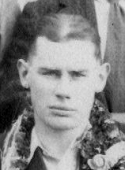
Winners hockey cup
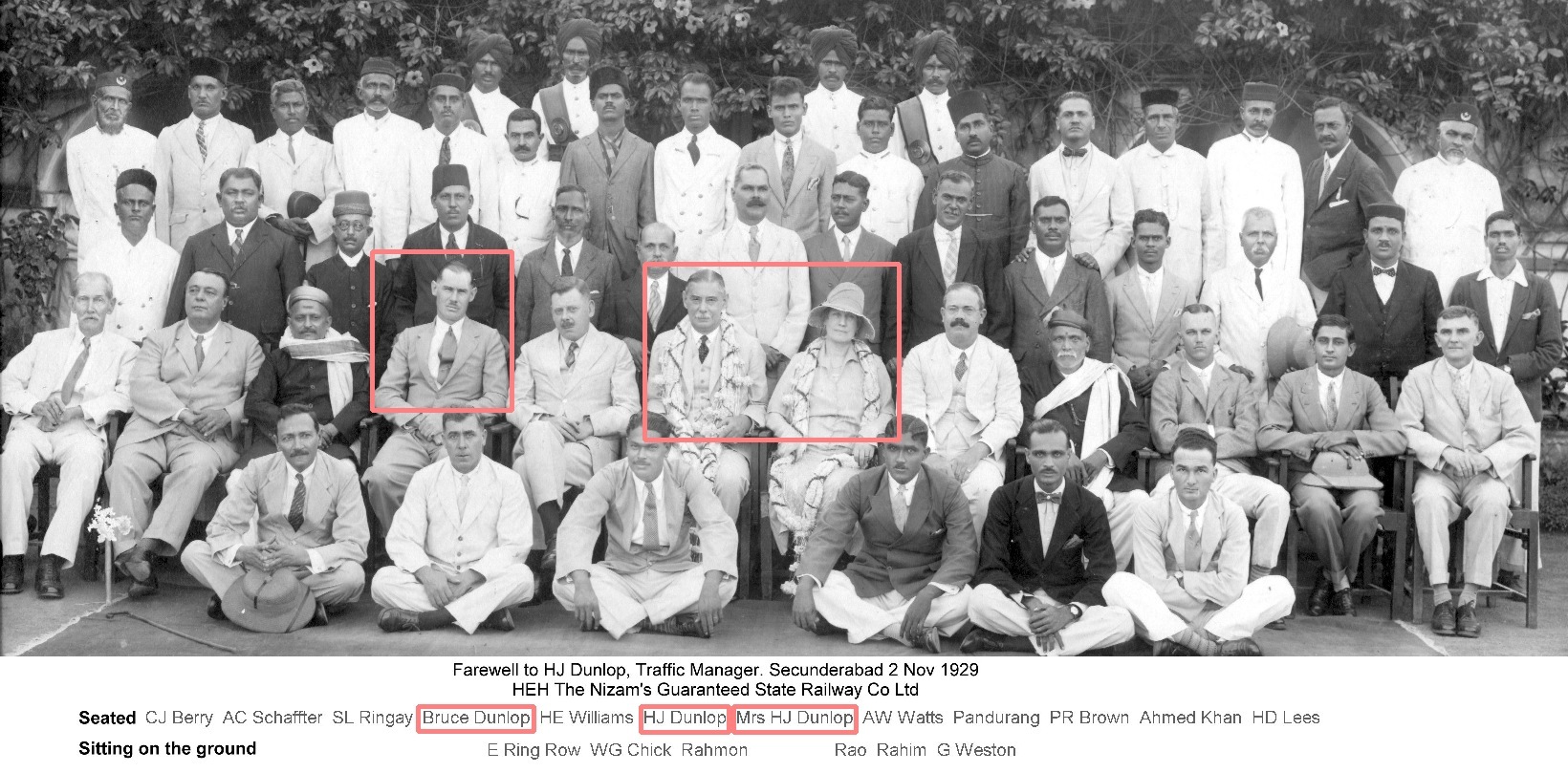
His grandfather (AJ) had achieved a substantial position in the Indian Civil Service, his father (HJ) had followed him and rose to be Traffic Manager of Nizam's Guaranteed State Railway (the Traffic Manager seems to have run the department which had dealings with customers). HJ retired in November 1929 and by 1936 Bruce was the Personnel Officer for the whole railway.
Alastair seems to have remained in UK throughout their time in India staying with the family. He always spoke of his home as being Greenock and so he was based at 29 Brisbane Street, Greenock; his mother’s parents’ address. The girls stayed with their parents in India until Pat was 7 when she returned to the UK and presumably to boarding school.
Roberta  went back to India with Jimmy until she also was 7 and then mother and daughter returned together to UK separated from Bruce until Roberta returned to India for a spell when Pat was aged 17.


It is notable that Bruce spent his first two years in India without his family and appears to have spent 5 years alone in India with two breaks of 4 months home leave between 1931 and 1936 (aged 35-40).
When he returned to India in September 1939 he was transferred to the Nizam’s Railways - Road Transport Department (the motor bus department) as Superintendent.

AHJ, Pat, Jimmy and Roberta 1938

Bruce's daughter Pat had a relationship with Stephen Jameson Wheler and gave birth to Stephen Bruce Jameson Wheler on 1st December 1943. In 1945 she married Keith Malcolm Anderson in Nottingham and gave birth to Rosalind Ianthe Anderson.
Jimmy married Captain Terry Lane RA on 15th August 1944 in St John's Church, Secunderabad and gave birth to their first son a year later in Hyderabad. She went on to have 6 more children.

Light Motor Patrol
Hyderabad Rifles 1935

The Zoo

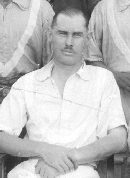
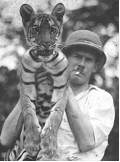
Bruce was a good all round sportsman, a skilled hockey player and a keen sailor. He was Commodore of the sailing club. He was President of the Secunderabad Club 1946-47. He was also active in Freemasonry. He had a great love for animals and kept what seemed to some to be a miniature zoo in which were a tiger cub, monkeys, crocodile and even a hyena (called Percy after his then boss).

Back Home

When India achieved independence in 1948 Bruce and  returned to UK. Roberta was suffering from a lung disease and died on 2nd November 1948 aged 52.
Bruce was living in Dorking and started Dunlop Cabs in 1949. He married Victoria Joan Assiter (born 8th June 1917) later that year.


Vicky Joan


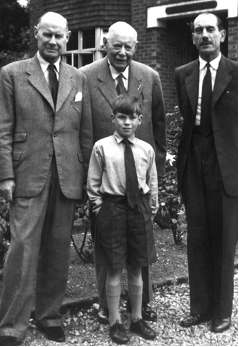
Four generations 12 July 1958
BAJ, HJ, AHJ (with BWJ)


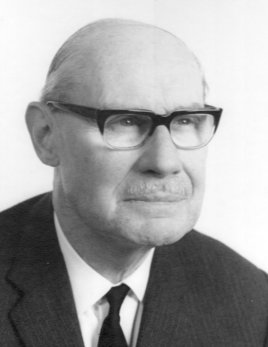
BAJ
c.1970


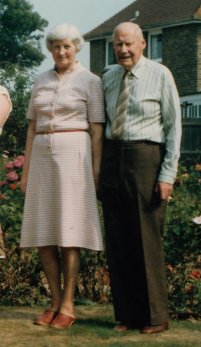
Joan and BAJ
c.1985

The Cab company was not a success and soon failed. Joan (Vicky-Joan) and Bruce moved to Garden Road in Bromley. Joan said that Bruce worked as a concierge/receptionist at a large London store or hotel until his retirement. They then moved to Amberley Road, Goring-by-Sea. He died on 26 November 1992 and is buried with Roberta at St James'Church, Abinger Common. Joan died in May 1999.

Army_record
Sources
Documents
Images