
The Burgh of Calton
In
the spring of 1837 set in an alarming stagnation of trade, which was felt
keenly in Calton and the East-end. Orders for goods almost ceased, and
manufacturers reduced the wages of the cotton-spinners, who struck work in
April. Finding the mills almost depopulated, there were many who either from
necessity, or from an ambition to improve their circumstances, "went
in" upon the cotton-spinners' labour. These were designated "Nobs," and on 22nd July, one of them, named John
Smith, was shot down on the streets. A few days afterwards a spinner, named
William M'Lean, was arrested at Campsie
on suspicion of having committed the murder, and on 29th July the committee of
the Glasgow Cotton Spinners' Association were arrested by Sheriff Allison and
Superintendent Millar, of the City Police, in the Blackboy
Tavern, Gallowgate. Twelve of them were subsequently
liberated, but five of the executive of the association, including M'Lean, were committed for trial charged with "having
formed an illegal conspiracy for the purpose of forcibly and illegally raising
or keeping up wages, or the price of labour, by means of writing or sending
threatening letters to masters or their managers, and wilfully setting fire to,
or attempting to set fire to the dwelling-houses, mills, or warehouses of
owners, masters, or their managers, and of forcibly invading the
dwelling-houses of workmen, and of assaulting and murdering workmen, or by
means of the perpetration of one or more of these unlawful acts, with the
illegal and felonious intent and purpose of thereby deterring and intimidating
them respectively from giving or taking employment at the rate of wages or on
the terms which they please."
The
sum of £1,000 was contributed for the defence of the accused. A long delay took
place before the prisoners were indicted for trial, and it was not until 3rd
January, 1838, that their trial commenced before the High Court at
The
names of the prisoners were :- Thomas Hunter,
president ; Peter Hacket, treasurer; Richard M'Neil, secretary; James Gibb, assistant secretary; and
William M'Lean, guard.
There
were twelve separate counts in the indictment, and the jury by 8 to 7 convicted
on four of the counts. They were each sentenced to seven years transportation.
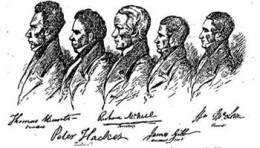
Portraits of the Executive of the Association
of
Public
opinion was sharply divided on the merits of the case. On the one side it was
argued that three actual murders, twice as many attempted murders, several
daring cases of incendiarism, with numerous cases of
assault, were clearly traced to the association, and that consequently the
punishment was too lenient. On the other side the friends of the prisoners
pointed out that the long delay in bringing them to trial, and the fact that
the jury only convicted by a majority of one, showed that the case against them
was very weak, and called for their liberation, or at least for a reduction of
their sentences.
In the
course of the trial, the mysterious murder of a widow, named M'Pherson, in Pollok's Land, Calton, was elucidated. It
appeared from the evidence that Mr. Dunlop, proprietor of Broomward
Factory, Calton, had filled his mill with female workers. A secret committee of
three was appointed by the Operative Cotton Spinners' Association to get the
women turned out of the mill. The committee was independent of control from the
main body of the association, but it was understood that they were to use every
means to put out the women who had taken the places of the male workers. They
first attempted to set fire to the mill, but failed. They then lay in wait for
the purpose of murdering a daughter of the woman M'Pherson,
who worked in the mill, with a view to intimidating the other women, but by
mistake killed the mother instead of the daughter. The murder was committed by
two men named Patton Dunlop and Bernard M'Kerry;
their passage money to
At the
Glasgow Circuit Court on 11th January, 1838, Thomas Riddle, an operative
cotton-spinner, was convicted of invading a dwelling-house in
The Edinburgh Review, Volume 33; Volume 67