APPENDIX "C". An Example of Japanese Offensive Tactics, Arakan—February, 1944
COMPOSITION OF JAPANESE FORCES ENGAGED—GIVEN IN THE ORDER IN WHICH THEY APPEAR IN THE NARRATIVE.
Tanahashi Force
Comd. Col. Tanahashi.
112 Inf. Regt. (less 1 Bn., less one M.M.G. PI).
2 Bn., 143 Inf. Regt. (less one Coy.), (one mtn. gun attd.).
3 Bn., 55 Mtn. Arty. Regt. (Mtn. guns 2, Light mortars 4).
55 Engineer Regt. (less one Coy. and two Plo, but with main strength of 10
River Crossing
Materials Coy. attd.). One Sec. Div. Wireless. Medical and Water Purifying
personnel.
Kubo Force
1 Bn., 213 Inf. Regiment (less one Coy. and one MMG PI.).
Sakurai Div. Inf. Group
Comd. Maj. Gen. Sakurai.
55 Diy. Inf. Group HQ. and protection troops.
Div. Inf. Group Wireless Sec.
Water Purifying personnel.
Doi Force
Comd. Col. Doi.
143 Inf. Regt. (less 2 Bn., less 5 Coy.).
2 Coy. Med. Arty, (less one PL).
2 Bn. and 8 Coy. Mtn. Arty.
One PI. Engineers.
One Sec. of Div. Wireless. Medical Detachment.
The Japanese Plan
After the monsoon the opposing forces advanced towards each other until, by the end of January, their "dispositions were those shown approximately on Map 1. Towards the end of January the Japanese appreciated that we were building up j>ur strength in the area North of Buthidaung, and in order to forestall any plans we may have had in view, they decided to assume the offensive. This was originally to have been launched about the middle of February, but, in view of the progress of our own preparations, the attack actually tobk place a fortnight earlier. The Japanese plan was an ambitious one and was intended first to drive out and destroy our division East of the Mayu Range, and then to destroy our division West of the Mayu Range. It was assumed that under the pressure of this offensive these two divisions would be driven into the Naf River. The Japanese force with which this narrative deals was, therefore, not only intended to destroy our forces East of the Maya Range, but also to cross the range and destroy our division which was in the Maungdaw area.
On the night of 3/4 February the Tanahashi and Kubo forces left the Dabrugyaung area and moved North up the East side of the Kalapanzin River (see Map 2), passing through an area occupied by one of our brigades without being seen or heard. By the morning of 4 February they had reached Taung Bazar without meeting any opposition. 2 Battalion, 143 Regiment attacked this place from the West and captured it after slight resistance.
This battalion then formed a bridgehead West of the Kalapanzin River, and the rest of the force, less 2 Battalion 112 Regiment, crossed the river, and concentrated in the area 3 miles West of Taung Bazar. 2 Battalion 112 Regiment, which had been detached before the main force reached Taung Bazar, by-passed our positions and crossed the river some 5 miles North of that place.
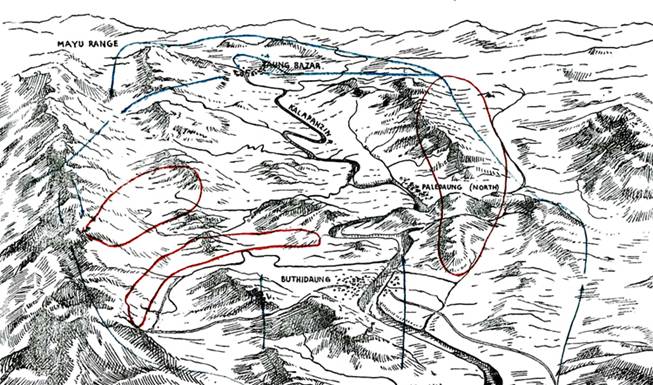
Drawing showing the general encirclement attempted by the Japanese,
On 5 February the Tanahashi and Kubo Forced were again divided. 2 Battalion 115
Regiment advanced southward towards the hills in the area of Shwechaing (see
Map 3) to prevent our withdrawal WeGtward through the pass at the foot of which
Shwechaing lies. They did not however, stay here, but continued South towards
Ngakyedauk. Our tacts met this battalion in the area of Badana and inflicted
heavy casualties, preventing further advance to Shweehaing by daylight. The
Japanese, however, reached this objective that night (5/6 February).
In the meanwhile, the restof this force advanced South with the intention of seizing the East end of the Ngakyedauk Pass, but at midday on 5 February they met serious opposition at Ingyaung. Hero, they attacked alJ day but failed to dislodge our troops and fell back incurring considerable losses.
Kubo force crossed the Moyu Range, leap-frogging through 2 Battalion 112 Regiment at Shwechaing and reaching the Bawli-Maungdaw Road in the area of Cliota Maunghuama on the night of 5/6 February. Here, they damaged three bridges, and withdrew into the foot hills, contact, then being lost.
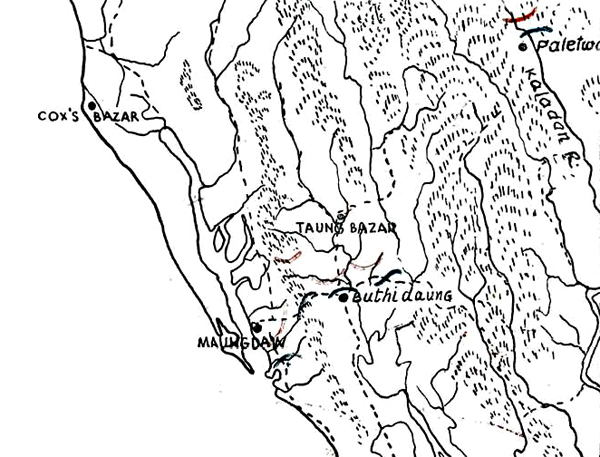
Map 1
During the night 5/6 February 2 Battalion 112 Regiment infiltrated southwards, and by 0400 hours 6 February they had reached the area at the East end of the Ngakyedauk Pass. At 0500 hours they attacked and overran our divisional headquarters, but were later driven out.
Major General Sakurai, who was directing the operation, now decided that he could not wait for Colonel Tanahashi to close the Ngakyedauk Pass, and frontal attacks were made repeatedly on 6 and 7 February in the Sinohbyin area, 2 Battalion 114 Regiment, which had just been brought forward, taking part. All these attacks were repulsed.
Meanwhile, 2 Battalion 112 Regiment had established a strong road block on the Ngakyedauk Pass and were attacking the southern end. Enemy troops had succeeded in infiltrating along the Eastern slopes of the Mayu Eidge during the night 6/7th February, and there were about 100 Japanese South of Kreingyauug on the Tatmin Chaung. This chaung was being used by the enemy as an L. of C. Between 00 and 70 coolies carrying rations were captured by us at Tatmin-gyaungwa on 7 February.
The situation in the Ingyaung area had become very confused, small parties of our own and' Japanese troops becoming inextricably mixed, so that the latter could make no concerted attack.
From 7 to 8 February numerous email actions were fought, but without any decisive result. On fifth February Doi Force, in position astride the Mayu Range, continued to launch diversionary attacks on the main front, and extended this activity to Maungdaw.
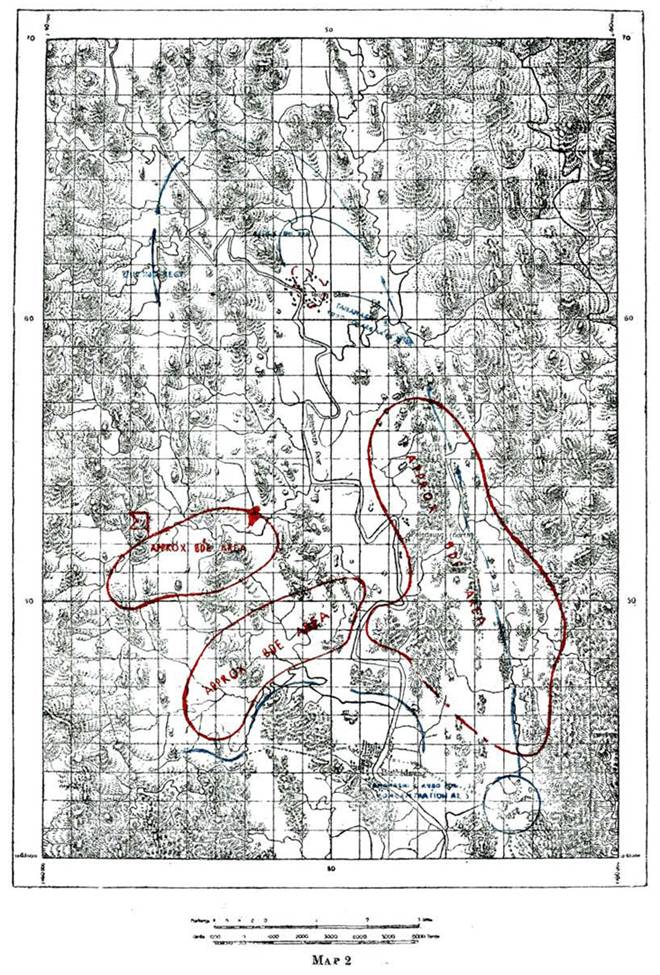
Map 2
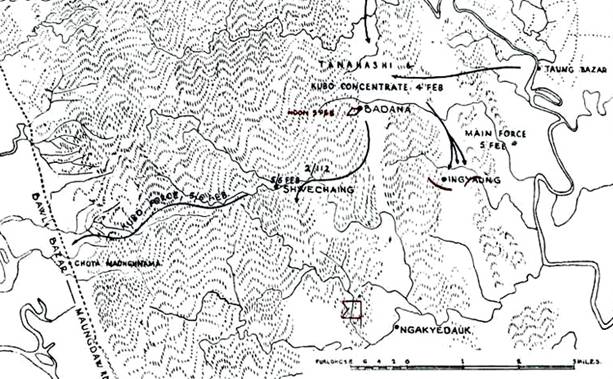
Map 3
Meanwhile, Colonel Tanahashi had been pushing that part of his main body which
was still concentrated South from Ingyaung through the hills, and by 9 February
this force was spread out from the Badana Chaung south through the hills to
Awlanbyin.
Lt. General Hanaya, the Commander of the Division, had by now abandoned hope of destroying our divisions West of the Range, and ordered the Tanahashi Force to concentrate in Sinzweya area with the intention of destroying our forces there. On the same day we began to attack the Japanese in the area of the pass, where we captured positions and held them in spite of heavy counter-attacks by the Japanese on 10 and 11 February. The Japanese still held positions covering the Pass.
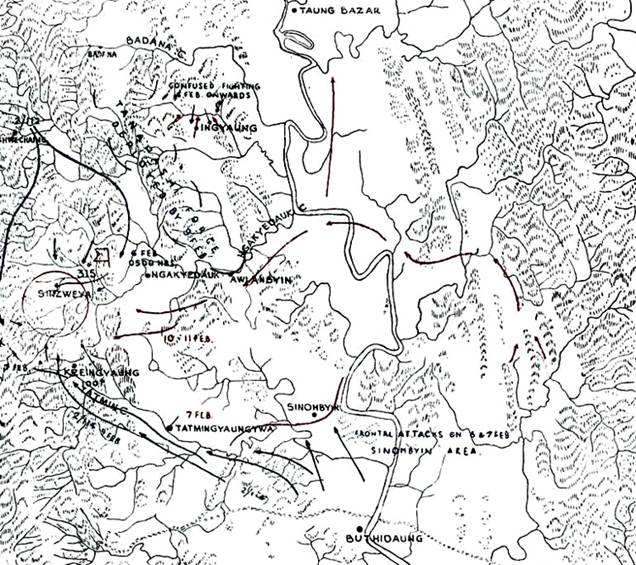
Map 4
During 9 and 10 February, the Japanese, as ordered, had been heavily attacking in the Sinzweya—Ngakyedauk area from North and South. The bulk of the Tanahashi Force was in the area Hill 315, and 2 battalion 144 Regiment had been taken from the Sinohbyin area for this attack, but the Japanese were unable to achieve any success.
By 11 February the Japanese had been put on the defensive generally, except in the areas Ngangyaung Bawli Road and on the Eastern slopes of the Mayu Range West of Ngakyedauk, where he was concentrating his efforts against our divisional box. By 13 February the Japanese had lost the initiative, and were suffering from difficulties of supply of both ammunition and food. From this date onwards the action became defensive on the Japanese side, while they attempted to withdraw.
The operation had provided another instance of how the Japanese, over-confident from their early successes, are inclined to use the minimum troops which they think are required to do the job. In this they diverge from German teachings which they follow so closely in many other respects. In this case, they used the minimum force and kept no reserves; and, when the operation failed, Colonel Tanahashi upon whose force the effectiveness of the encircling movement depended was, after being put on L. of C. duties in charge of the collection of supplies, sent back to Japan.
JAPANESE
IN BATTLE
2nd Edition
GENERAL HEADQUARTERS , INDIA
MILITARY INTELLIGENCE DIRECTORATE
9329 K/G. S. I. (t) (i) AUGUST 1944
THIS DOCUMENT MUST HOT FALL INTO ENEMY HANDS
http://www.allworldwars.com/Japanese-in-Battle.html