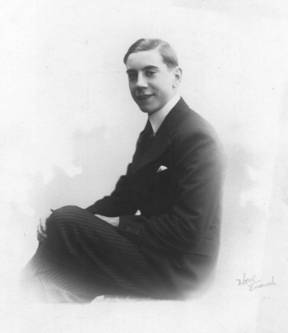
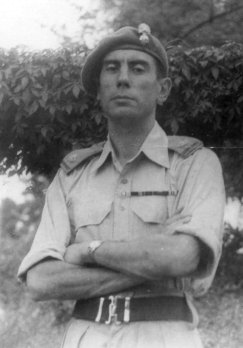
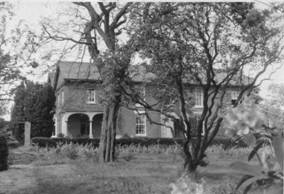
Alastair Henry Johnstone Dunlop
Alastair was born in Greenock on
30th October 1917. His father left for India when he was 18 months old
with his sister Margaret Jean (Pat) being born shortly after that. His
mother left him with her parents James and Sarah Brown at 29 Brisbane
Street, Greenock and with Margaret joined his father in India when he
was 3 years old. His grandfather was a print worker and later a
journalist. He wrote a touching poem about his grandson’s early
words which is included as an annex. Alastair went to firstly to
Greenock Academy, then (aged eight) to his Prep School - Warriston
School, Moffat. He didn’t see his father and mother again until
they returned on leave in 1926. They also brought back his sisters:
Margaret and Jaqueline Bruce (who had been born in India). His father
returned to India four months later followed by his mother with
Jaqueline just before his 10th birthday.
Alastair was looked after by his
mother’s family in Greenock. His grandparents were old (late
60s). He was particularly close to Roberta’s sister Margaret. His
grandfather James died when he was 11 in 1930. (His Dunlop grandparents
lived in India until they returned to Bedford in 1929 and his
grandmother Grace died in 1933).


Roberta, Margaret, AHJ AHJ, Jimmy, Margaret
His parents returned to UK in time
to see him off to boarding school. He arrived at Sedbergh in March 1931
(aged 13) and left by March 1936 (aged 19).
His mother stayed in UK during this
period and he presumably spent the school holidays with her and his
sisters (Margaret and Jimmy).
His grandmother Sarah died while he
was he was in serving in India in 1942. His aunt Maggie who had
presumably looked after him as a young child and wrote to him regularly
during the war died from MS in April 1945 aged 57. This was as he was
advancing through Burma following the Irrawaddy Crossing.
He was a gentleman cadet at the Royal Military College,
Sandhurst from 28 August 1936 – 18 December 1937. He was
commissioned as a 2nd Lieutenant on 27th January 1938. (aged 20).
In February 1938 he flew to India.
He joined on attachment 1st Battalion the Wiltshire Regiment in
Bangalore in April 1938, a sort of probationary year under instruction
to mature into viable infantry officer.
He was posted to 1st Battalion 4th Bombay Grenadiers in April 1939.
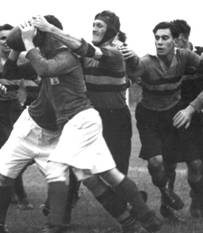
Rugby for the Wiltshire Regiment
On 1st September 1939 Germany invaded Poland marking the beginning of Second World War.
The 3rd Battalion 4th Bombay
Grenadiers was raised in November 1940 at Nasirabad and AHJ was
transferred to it as a temporary Captain (aged 23). They were stationed
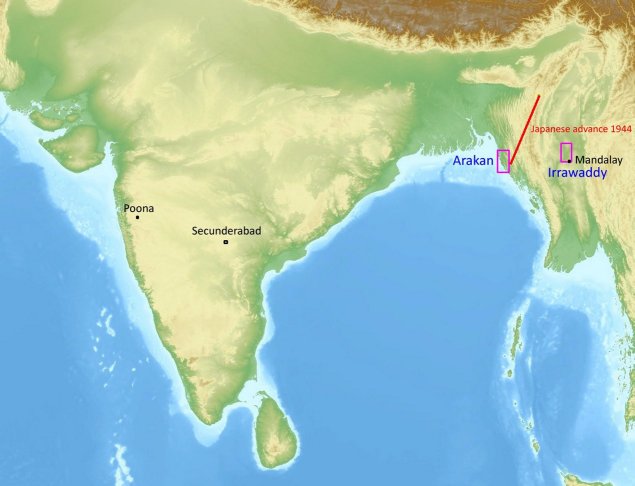
near Poona (now called Pune) and were trained in tank close-support
operations.
Regimental abbreviation:
British Army - 1 Wilts = 1st
Battalion Wiltshire Regiment (they do not show their Regimental number
though they are by precedence the 62nd Regiment).
Indian Army – regiments show
their Regimental number (from 1st-20th). Bombay Grenadiers are the 4th
Regiment and found 13 battalions during World War II.
The Allied involvement in war in Burma was fought mainly by the Indian Army who formed 75% of the fighting strength.
Indian Army ranks: Jemadar=Lieutenant, Havildar=Sergeant, Naik= Corporal, Sepoy=Private
On 8th December 1941 Japan invaded
Malaya. They launched simultaneous surprise attacks on Australian,
British, Dutch and US territories (Pearl Harbour). By 15th February
1942 Japan had captured Malaya; and Singapore had surrendered. British
casualties amounted to 8,708 killed or wounded and 130,000 captured.
Japan transferred its attention to the invasion of India through Burma
and by May 1942 the British had been pushed back to the Indian border.
The Monsoon means that major
operations are effectively impossible for the months of June to October
but the Japanese made no significant advances
During 1943 General Slim was
preparing to take the offensive the following year. His new doctrine
dictated that, if the Japanese had cut our lines of communication, then
they too would be surrounded. All units were to form defensive 'boxes',
to be resupplied by air and assisted by integrated close air support
and armour: ready day for counter attack.
The 25 Dragoons (25 D) were a tank
regiment with total of some 54 Grant tanks. Attached were A Company 3/4
Bombay Grenadiers (A Coy 3/4 Bombay Gren) commanded by AHJ. A Coy
consisted of three rifle platoons who were transported by their own
trucks. They also had a carrier platoon commanded by Lt Bannerji. Their
total strength was about 180.
In late 1943, the British began
tentative advances into Arakan. 25 Dragoons were moved from India to
the Mayu peninsular under great secrecy in preparation for an attack on
Japanese forces.
(Burma is now called Mayamar, Arakan is now called Rakhine.)
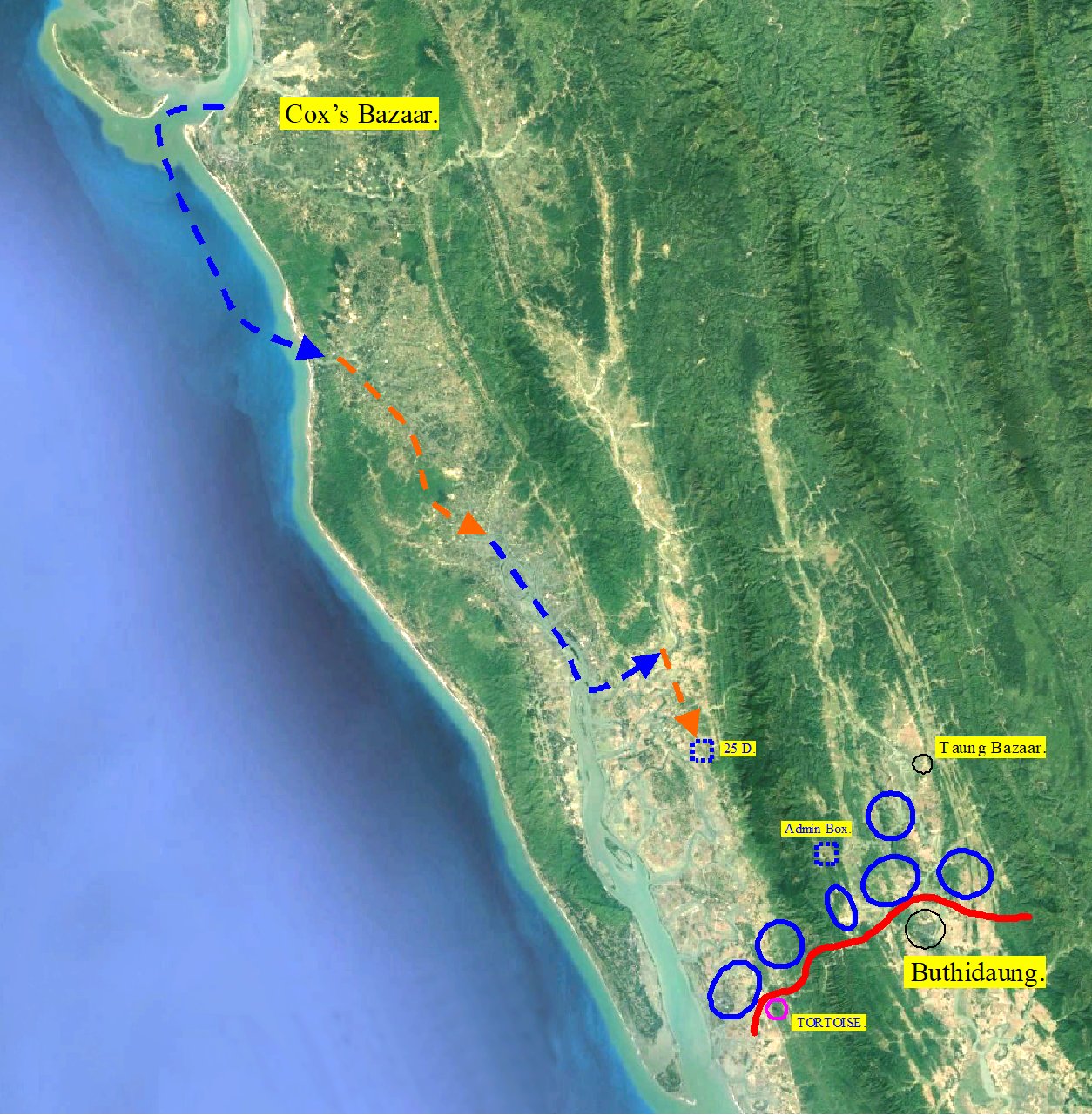
A Coy with 25 D arrived in Cox’s Bazaar in December 1943.
They moved by track and ferry to a harbour position behind the British brigades.
Attack on TORTOISE
Operation JONATHAN – 26
January 1944. C Sqn 25 D prepared support an assault by 4/7
Rajputs on Japanese fortifications at Razabil. The feature at the West
end of the pass to Buthidaung was given the codename TORTOISE. The
preparatory air strike hit the tank assembly area killing one, wounding
two and damaging three tanks. The subsequent attack was supported by
two carriers with medium machine-guns of A Coy. However it was
insufficiently coordinated and had to be called off.
During this operation three of A Company were wounded including AHJ who had been shot through the hand.
25 D supported further attacks on
TORTOISE over the next 3 days and improved their support by firing High
Explosive rounds until the assaulting infantry were close to the enemy
positions when they switched to Armour Piercing shot. This technique
proved invaluable in all future infantry/tank operations. Even so they
were unable to secure the feature.
Battle of the Box
On 1 February 1944 a plan was made
for 25 D (with A Coy 3/4 Bombay Gren) to cross the Mayu range to attack
Buthidaung with a Gurkha battalion under command. The Advance Party
crossing began on 2 February and was complete on 3 February. Meanwhile
a Japanese force of some 8000 men had infiltrated through the British
brigades. B Sqn was ordered across the Mayu range immediately. A and C
Sqns and Regt HQ crossed that night. By morning 7 Indian Div was
surrounded and the enemy force were assaulting from the rear.
At dawn on 6th February the
Headquarters of 7th Divisional was attacked. Most of the Divisional
Staff escaped but some were still engaging the attackers, a troop of
tanks of 25 D arrived and assuming that it was held by the Japanese
engaged the British positions. Shortly after this the remnants of the
HQ withdrew. There was a very confused situation with B and C Sqn
concentrated in the Div Admin Area (Admin Box) at Sinzweya. Lt Bannerji
with his carrier platoon evacuated 12 wounded under fire from Div HQ
for which he was awarded the MC. The Japanese took up positions
overlooking the Box and at 18:00 engaged it with mortar and machine
guns. A Coy Bombay Gren suffered one killed. That night the Japanese
overran the medical facility (Main Dressing Station – MDS) where
they bayoneted the patients and took the medical staff prisoner. They
later executed the staff. 35 were killed though 9 had escaped. On 9
February a company of 2 W Yorks attacked the Japanese position in the
MDS killing 45 enemy. During that night two patrols of A Company in the
nullahs forward of the tank harbour area came into contact with large
fighting patrols. One section of seven men killed twelve enemy for the
loss of one killed. A total of sixteen enemy dead were recovered.
On the following night A Company was attacked and accounted for twenty
five Japanese killed. The platoon commander, Jemadar Ram Sarup, was
awarded a Mention-in-Despatches.
The position was consolidated with A
Company patrols forward of the tanks providing close protection. During
the day tanks would support brigade infantry assaults on surrounding
Japanese positions. (A Company secured the harbour area during these
operations). By night the tanks withdrew to the harbour area. Japanese
had blocked supply routes for the whole Corps and resupply was carried
out by air.
(interestingly Major Alec Charles Dunlop commanded B Coy 2 West Yorks during the battle).

By
the 16th February a relief forces from the North had reached the Box
and though fighting continued the British had demonstrated that they
held the upper hand.
“At
dusk one evening a large party, bayonets fixed, descended from the
hills near Point 315 with a view to rushing 'C' Squadron tanks. They
first of all met the 3/4th Bombay Grenadiers who were in slit trenches
in front of the tanks, precisely to meet such a move Standing in his
slit trench, it is said, an Indian officer saw one of the enemy coming
straight towards him and shot him dead at short range, but the Jap was
carried by his own impetus right into the trench, knocking the officer
down and pinning him on the ground at the bottom. His shouts for
assistance attracted the attention of another of the enemy who, jumping
into the trench, landed on top of the dead Japanese. He put his arms
round the dead body and reaching down to the Indian officer began to
strangle him with his bare hands. Hearing the shouting a sepoy in a
nearby trench threw a grenade which landed on top of the second Jap,
exploded and killed him. The officer was unhurt. The remainder of the
Bombay Grenadiers acted with similar bravery and, with some firing from
the tanks over their heads, the attack was defeated. Not a single
Japanese soldier reached the tanks.”
By 22nd February, the Japanese had been starving for several days. The
commander of the Japanese 112th Infantry Regiment, which provided the
main body of attacking force, stated that his regiment was reduced to
400 men out of an original strength of 2150 and refused to make further
attacks. On 24th February, he retreated without authorisation. On 26th
February, the Japanese were ordered to break off the operation.
The British had suffered 3,506
casualties but had managed to hold its ground, thus giving a tremendous
fillip to morale throughout the army in India. The Japanese had lost
3,106 dead and 2,229 wounded.
Capture of BUTHIDAUNG
The relief had been performed by two
fresh British divisions which took over the front and planned for the
advance southward. These were very well prepared attacks and the
Japanese were considerably weakened. The first assaults occurred on 7th
March and inexorably Buthidaung was taken.
There followed well planned and coordinated attacks using tank support but with A Company securing the approaches at all times.
On 13th March a platoon of A Company
while clearing a small feature to the South East of Buthidaung lost 2
killed and four wounded. It was in this incident in which AHJ’s
orderly – Siri Chand was killed. Whilst attending to him AHJ was
rushed by an enemy officer whom he killed with his sten gun.
Japanese positions around Buthidaung
were cleared during March but it became clear that they would not be
defeated that year and with the monsoon approaching it was necessary to
move back to secure positions. The British moved back to the line that
they had occupied before the assault on Buthidaung with 25 D being
withdrawn from theatre as tanks could not operate during the monsoon.
On 25th April A Company moved to
Cox’s Bazaar (less one platoon with A Sqn) and later returned to
Poona in India for rest and re-equipment. It rejoined its own battalion
in November 1944.
A Company casualties between January and April were: 7 killed and 7 wounded.
The following A Company soldiers were killed:

The following Awards for Gallantry were made:
Military Cross
Lieutenant Sumil Kumar Bannerji
Mentioned in Despatches
Major A. H. J. Dunlop.
Jemadar Ram Sarup.
Lance.Naik Kunhi Ramon Nair.
Sepoy Siri Ram
Irrawaddy Crossing
On 28th January 1945 A Company was
attached to the 150th Regiment RAC in the role of close protection to
tanks. They were in action with the 19th Indian Infantry Division
taking part in the re-conquest of Burma. 19 Division was tasked with
crossing the Irrawaddy 45 miles North of Mandalay in a diversionary
move in order to prevent the Japanese concentrating forces against the
main crossing to the West of Mandalay.
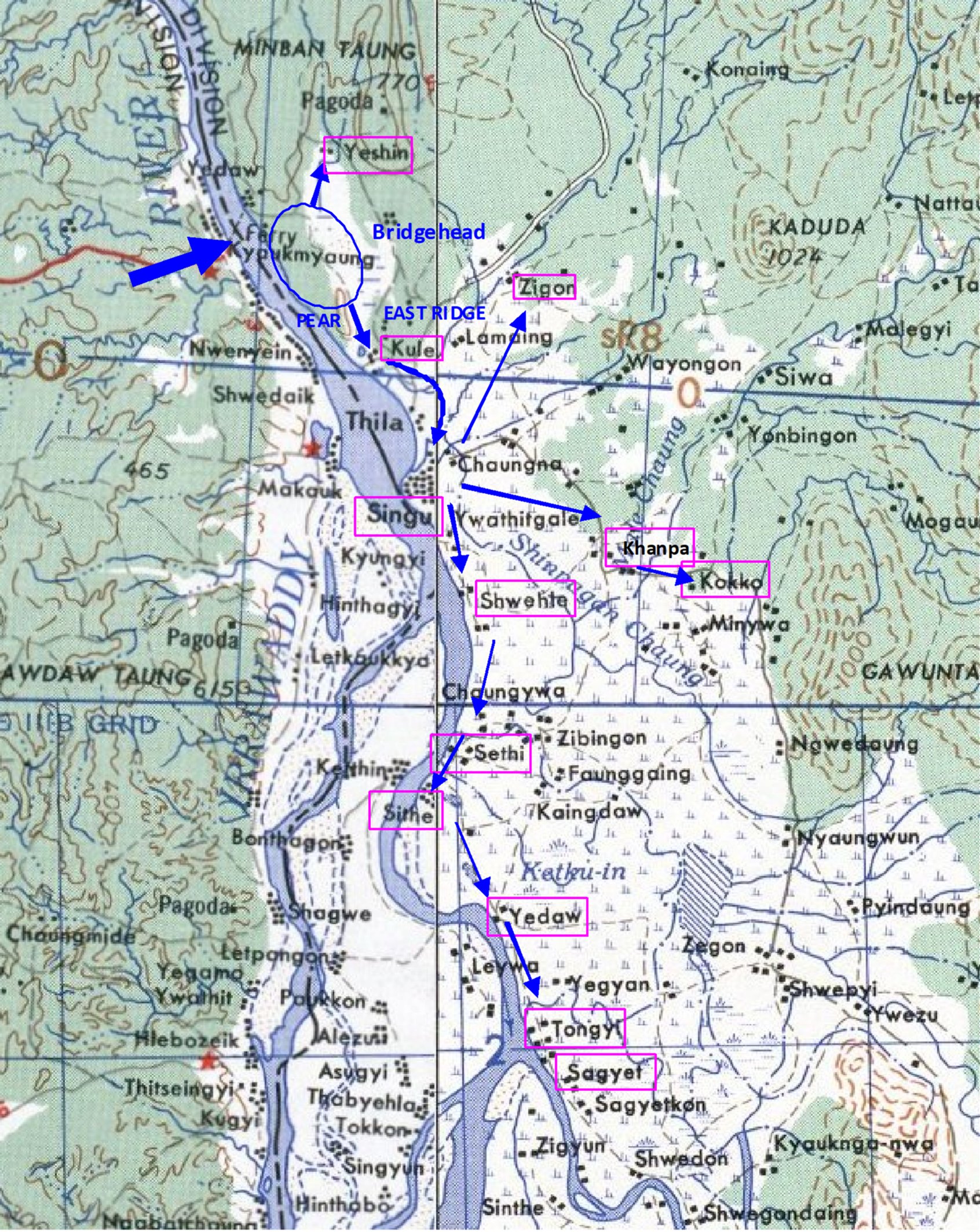
The assault troops of 19 Division crossed at Kyaukmyaung on 14th
January 1945 to form a bridgehead. A Company with C Squadron 150
Regiment (some 15 tanks) crossed on 1st February. They were tasked with
supporting the infantry in expanding the bridgehead.
On the 3rd February an attempt was
made to clear the road from the bridgehead to Yeshin. 4/6 Gurkha Rifles
and a squadron of tanks with AHJ and two platoons of A Company set out
along the main track. The enemy waited until they reached Yeshin and
then brought down very heavy and accurate shellfire on them. A relief
column was sent out the following day and altogether there were 41
killed and 119 wounded. A Company lost two killed and five wounded. AHJ
described this incident as the most terrifying of his wartime service.
On 7th February the company took
part in an attack on Kule along with three troops of tanks and the 2nd
Worcesters. Clearing Kule took two days. Here they saw some of the
severest fighting of the campaign and much sniping was encountered. A
Company, which at times had to advance in front of the leading tanks,
sustained two killed and thirteen wounded.
On 9 February he wrote in his diary
“My company strength is now 3 platoons of 20 men each and I have
no officers left. Pirthi wounded on 4th, Kamal Singh on the 7th. Rested
all day and cleaned up. The troops are amazingly good, we've lost ? of
our strength in 4 days & they are as cheerful as ever, bloody good
blokes.“
The bridgehead was repositioned at
Kule. A Company with C Squadron and 4/6 Gurkha Rifles took Kanpha.
There was very heavy opposition and they suffered one killed and five
wounded. In spite of an initial setback the area was finally cleared on
the 17th February.
From their base in Kule they took
part in the capture of Zigon and Shwehle on the 23rd, Kokko on the
26th, and Sethi on the 27th.
They moved their base to Singu and
on 2nd March two platoons of A Company under the company Second in
Command, Lt Bacha Jadav, and C Squadron made an attack on Taungyi
(Tongyi) with the 4/6 Gurkha Rifles. Encountering stiff Japanese
opposition the company lost three killed and seven wounded. For his
bravery evacuating the wounded in this action Sepoy Ram Singh was
awarded the Military Medal.
From 2nd to 7th March the force made
a rapid advance towards Mandalay. On the 8th March at Kabaing they came
across an enemy force “The Bombay Grenadiers made a series of
bayonet charges under cover of the tanks and accounted for 30 Japs
without a single casualty to themselves”. On the morning of 9th,
a platoon of A Company with a troop of tanks supported 2 Berkshire
Regiment in clearing a chaung. The infantry were held up but Jemadar
Daryao Singh led his platoon to assault to take the bunkers
responsible. He was awarded the Military Cross and Havildar Dalip Singh
the Military Medal for this action. That afternoon two platoons of A
Company supported an attack by 8/12 FFR on the north-west gate of the
Fort Dufferin. A Company lost one killed by friendly artillery on the
approach and the assault was unsuccessful. A further attempt was made
on 10th March again unsuccessful “The very greatest bravery was
shown by Indian stretcher bearers recovering casualties from right
under the FORT wall and also by personnel of A Company 3/4 Bombay
Grenadiers in recovering their own casualties”.
Mandalay Hill was eventually
captured on 11th March. On the 14th one of the Lees was hit and burst
into flames. Sepoy Gordhan climbed on to the burning tank and helped
five of the crew to escape unfortunately all the crew later died. On
the night of 19th/20th March the Japanese evacuated the town. On the
20th A Company led C Squadron inside the fort and after mopping up
reported it clear of the Japanese.
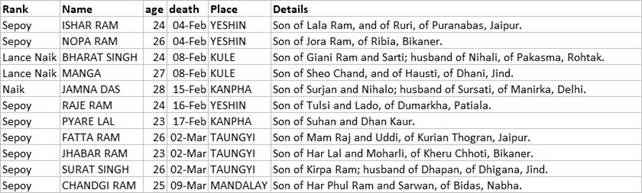
February and March had seen A Company suffer 11 killed and 39 wounded from a strength of about 120.
After the fall of Mandalay A Company
with C Squadron the 150th Regiment came under command of the 20th
Infantry Division. They reached Magwe on 20th April where they captured
800 Indian National Army personnel.
3/4 Bombay Gren continued with mopping up operations in Burma arriving at Rangoon by June 1945 and sailed for India in July 1945
Japan surrendered on 15th August 1945.
The following A Company soldiers were killed:
The following Awards for Gallantry were made:
Military Cross
Major AHJ, Dunlop (and bar)
Jemadar Daryao Singh
Military Medal
Havildar Dalip Singh
Naik Muttra Ram
Sepoy Sheo Narain
Sepoy Ram Singh
Mentioned In Despatches
Subedar Kanwal Singh
Sepoy Ram Dhari
Certificates Of Gallantry
Havildar Daryao Singh
Naik Mohd Ashraf
In
November 1945 the 4th Bombay Grenadiers was renamed Indian Grenadiers
and the same month Major AHJ Dunlop assumed Command of the Training
Battalion at the Regimental Centre in Nasirabad.
In February 1946
a riot broke out by Japanese civilians interned at Deoli (this was the
camp for interning the 2000 Japanese civilian internees from throughout
the Empire). Major Dunlop arrived with a platoon and, with only his
orderly, entered the camp to speak to the rioters. Meanwhile his
platoon entered the camp behind them. When the platoon was spotted, the
rioters made to attack them and the platoon opened fire. Nineteen
Japanese were killed. A woman came towards Major Dunlop with her
clothing pulled apart calling upon him to shoot her too. The Havildar
Major did so and then revealed that she had been concealing a knife as
she had approached.
In October 1946 AHJ was attached to the Secunderabad SB Area HQ.
The Punjab Boundary Force and Partition
In January 1947 AHJ was posted to 1st Battalion Indian Grenadiers as battalion second in command. “It
was located at Poona and was ordered to move to Amritsar to report to
the P.B.F. The battalion was ordered to restore law and order in this
city through which large numbers of refugees were later to pass. The
men patrolled the narrow lanes, of the old city and gave succour to
many helpless and starving people. Their impartial treatment and
selfless behaviour soon got the better of the communal mobs, and after
incessant patrolling for a week, some semblance of order was restored.
The 1st was then
ordered from Amritsar to Dera Baba Nanak and was made responsible for
conducting refugees across the railroad bridge over the river Ravi. It
sent out detachments to Batala, Qadian and Gurdaspur, and with
intensive patrolling, restored confidence amongst the people. Soon the
atmosphere was stable enough to start the exchange of population. The
battalion was first responsible for protecting the Muslim camps in
Batala area, but when they were evacuated without any mishap, it lost
its Rajputana Musulmans who were allocated to Pakistan (Muslim soldiers
were withdrawn and moved to Pakistan)…
The 1st had to
escort columns of twenty to thirty thousand Muslim refugees from
Ludhiana to Ferozepore. A column was 25 to 30 km long, moving along the
road in packed formation with the bullock carts moving abreast, loaded
to the brim with household effects on which were perched children, and
surrounded by all the household members walking on foot. Either side of
the road was filled with men and women driving cattle, sheep, donkeys
and camels. The foot convoy started every day at early dawn, and
settled down before sunset after doing about 15 km. Here they were
protected by the 1st Indian Grenadiers. Throughout November and
December the 1st was on this refugee-convoy duty.” from The Grenadiers A Tradition of Valour by Colonel RD Palsokar
The Partition of India produced the
largest mass migration in human history with some 11 million refugees
with between one and two million killed. The above account does not
record how that as the same time as being tasked with combating
communal violence the battalions of the Indian Army were being
reorganised on ethnic-religious lines with officers and soldiers being
stripped out of the British Indian Army battalions to form the new
national armies of India and Pakistan. The Punjab Boundary Force had
become operational on 1st August 1947, but was disbanded on 1st
September because of its ineffectiveness in controlling the riots
breaking out in consequence of Partition.
Partition formally took place on 15th August 1947.
Responsibility for attempting to maintain order was passed to the new national armies of India and Pakistan.
In an incident
on a convoy AHJ was close to an attack by a man armed with a sword who
killed one of the men in the convoy. AHJ chased after him with his
pistol firing until it was empty and eventually tackled the assailant.
AHJ was involved
in an incident when driving through a village with his driver. He saw a
Sikh with a large battle-axe in his belt. He approached the man to
confiscate it (it was unlawful to carry weapons in public). He pointed
his pistol at him and ordered him to surrender it. Whilst
reaching to take it the man drew the weapon backwards and as this was
threatening AHJ shot him. He drove the wounded man to hospital but he
died en route.
Return to UK
With Independence the vast majority
of British officers opted to transfer to the British Army or retire.
AHJ was offered a commission in the Royal Artillery. In February 1948
AHJ returned to UK. On 29 April 1948 he was attached to 82 HAA Regt RA
and on 11 January 1949 posted to 59 HAA Regt RA at The Barracks,
Pontefract. Here he met Beryl May Holden and they married on 15
November 1949.
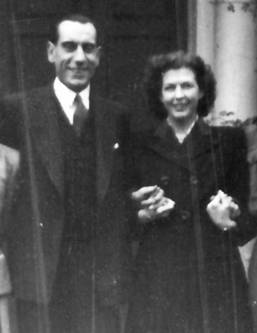
On 13 January 1950 he and Beryl travelled to Pakistan to attend the
Staff College at Quetta. BWJ was born. AHJ, Beryl and BWJ returned to
UK by sea in April 1951. He was appointed Brigade Major to a TA
Artillery Brigade in Nottingham. They spent 2 years there (16 Harlaxton
Drive) and Susan was born.
He had a short spell with a gunner regiment in Colchester before being
posted to 48 Field Regiment in Essen (Am Hagenbusch 20). There Ian was
born. He was posted to HQ Rhine District in Dusseldorf in June 1955 and
the following year to 20 Field Regiment in Colchester as Battery
Commander.
With his battery he was sent to
Cyprus late in 1956 as part of Operation MUSKETEER (the
Israeli/British/French invasion of Egypt: known as the Suez
Crisis) but they were not deployed to Egypt. We lived at Homefield
Road and here Andrew was born. Later we moved to Meadow Road. AHJ
retired from the Army receiving a useful redundancy payment in October
1958.
With his gratuity and redundancy
settlement AHJ and Beryl bought Ballast Quay House just outside
Wivenhoe. This came with 10 acres of garden, orchard and pasture. They
set up as a children’s holiday home. The idea was to provide a
home for children who were at boarding school in UK but whose parents
were abroad. There were children of many nationalities who stayed with
us. I particularly remember being friends with Turkish and Persian
children (the Persians were the sons of a family later ousted in the
Iranian Revolution).
There John, Grace and Jacqueline
were born. However AHJ and Beryl had not seen that the changes in
transport and society would reduce the viability of the
children’s holiday home. The business was not sufficiently
profitable and it was decided to move closer to Beryl’s family in
Yorkshire. The house had been bought for £2000 but was sold for
£10,000.
We moved to Doncaster in 1964. Beryl
continued as a housewife but started an Open University degree in
Mathematics. AHJ used the proceeds of the sale of Ballast Quay House to
buy 16 Avenue Road but also a potato washing and packing factory in
Bawtry. Today almost all potatoes are sold washed and in plastic bags.
However they had been misled about the profitability of this business
and it also soon failed. AHJ was left with no income nor a job. He
searched desperately and eventually was forced to take a job as a low
grade clerk with International Harvester. He found this low paid job
demeaning though he made friends with his colleagues and the family
struggled to manage financially (although I was never aware of this).
In 1968 he applied for and was appointed Permanent-Staff
Administrative-Officer at the local Territorial-Army Transport-Squadron
at Sandford Road Barracks on 11 June 1968 (219 Sqn RCT (V) TA). He was
highly respected in this job and happy with his position. He regularly
attended the two week Annual Camp in Germany between 1968 and 1973.
Beryl gained a degree in Mathematics and was employed as a Lab
Technician at a local school. During this time they moved two houses
along to 18 Avenue Road.
He eventually retired in 1982. Beryl
continued to work until 1986 and shortly afterwards they moved to
Fitzwell Cottage, Docking in Norfolk.
They lived there happily becoming
well liked figures in the local community. Then Beryl had a recurrence
of cancer and died on 13th September 2000. AHJ moved to a lovely care
home near to Susan at Pilham Hall, Gainsborough. His health had been
deteriorating for several years and by now the emphysema confined him
to bed and required an oxygen supply. He died peacefully on 12th
June 2003.
After-note:
James Brown was a journalist and wrote this poem about his 2 year old grandson Alastair.
HILLO FA'YA!
When I’ve finished for the day,
And I reach my dear home door,
Then my worries fly away,
And they trouble me no more;
For a little grandson meets me,
To a fine emotion treats me
As his childish treble greets me --
“Hillo fa'ya"!
He’s a witching dear wee lad;
Now he’s two and grown up, rather!
Won’t say “Grandpa" nor " Grand dad,"
Does he know to call me, “Father";
But that word he can’t get round it
For his tongue will twist, confound it!
Still, it’s sweet to hear him sound it --
“Hillo, fa’ya"!
When the children of our own
Leave the home nest, far to stray,
And the old folk still live on,
Missing loved ones gone away;
Children’s children's voices bring
To our lives a second spring,
When, like fairy bells they ring --
“Hillo fa'ya"!
They recall the long ago.
Ere by Time our babes were whirled
To the tides that ebb and flow
Round the margins of the world;
And some lisping voice comes clear,
Calling from another sphere—
Nearer with each passing year --
“Hillo fa'ya"!
Sweet this thought: As life moves on.
Though we lose our early toys,
Every year sees something won,
Every age gains newer Joys.
It may help, when life is o'er,
And we falter at that 'Door.
One will say--long passed before --
“Hillo fa'ya"!
James Brown (1919)
Sources:
Personal Diary of Maj AHJ Dunlop 1 Jan – 9 Mar 1945
War Diary 25 Dragoons
War Diary 150 Regiment RAC (Y&L )
The Grenadiers A Tradition of Valour by Colonel RD Palsokar
(Based on Brig Rajendra Singh’s account and checked by Lt Col GL Roberts OBE)
AHJ documents
AHJ photos
AHJ interviewed for the National Army Museum 1993